
©白乐寒
Looking for Our True Life
An Interview on “Sea of Fertility” by Bella Han
In March 2026, I was interviewed by the China Science Fiction Research Center about my cyberpunk novelette “Sea of Fertility” (published in Clarkesworld #227, August 2025, and later recommended by Locus). It remains both my readers’ and my personal favorite.
We talked about the past and future of the Internet, the meaning of the Other, and what true life is.
I have reorganized the interview as follows. Please enjoy.
An Elegy for Cyberpunk
“Sea of Fertility” is a story set in the virtual city of Laputa, a kind of “reverse cyberpunk.” Back in 1981, Vernor Vinge imagined cyberpunk in True Names before the Internet even existed. But today, cyberpunk has become our reality.
“Sea of Fertility” is, in a sense, an elegy for cyberpunk. Perhaps, in the foreseeable future, we will only have “the cyber” without “the punk.”
In Laputa, a virtual city blossoming at the peak of human civilization, the protagonists begin to see its emptiness. From the very summit of the Internet, they trace their way backward to the roots of the network, searching for their beloved and the most essential thing that makes us human—or, in other words, our true life (la vraie vie).
Ghosts in the Shell
In Laputa, sensations are generated directly in its residents’ minds through programming: sight, sound, smell, touch… The residents spend sixteen hours a day in the virtual city, and return to their physical bodies for the remaining eight, to ninety-square-foot rooms where they eat, exercise, wash, and sleep.
In this story, the body remains the final anchor. If, as many people dream, we could upload our souls into cyberspace, then the entire human society would be overturned. Since we would no longer be human, we would no longer need to live as humans do.
The story is set on the eve of “uploading,” and the protagonists must make a choice: whether to upload their souls and become cyber ghosts, or to return to the earth and seek a life that feels more human.
I am not saying that everyone has to choose the body. But without the body, we become a new species. In the 1995 film Ghost in the Shell, the AI Puppet Master proposes to Motoko, inviting her to abandon her cyborg body, merge with it, and become a new form of life.
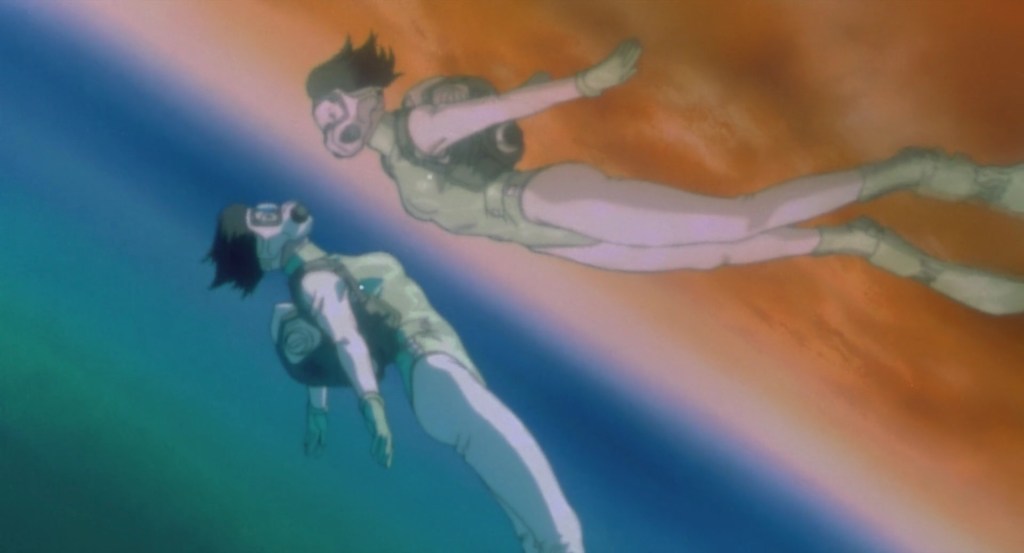
Are we willing to become a new kind of existence, to take new risks and explore new possibilities? Or do we still choose to remain human? In the story, the protagonists choose to return to the earth. Perhaps they believe that humanity, or human life itself, still has something precious. In the future, however, that choice belongs to you.
Broken Links
The structure of Laputa is inspired by Mont-Saint-Michel, as well as hell and purgatory in The Divine Comedy. But while Mont-Saint-Michel is crowned by a church, Laputa is a city without faith.
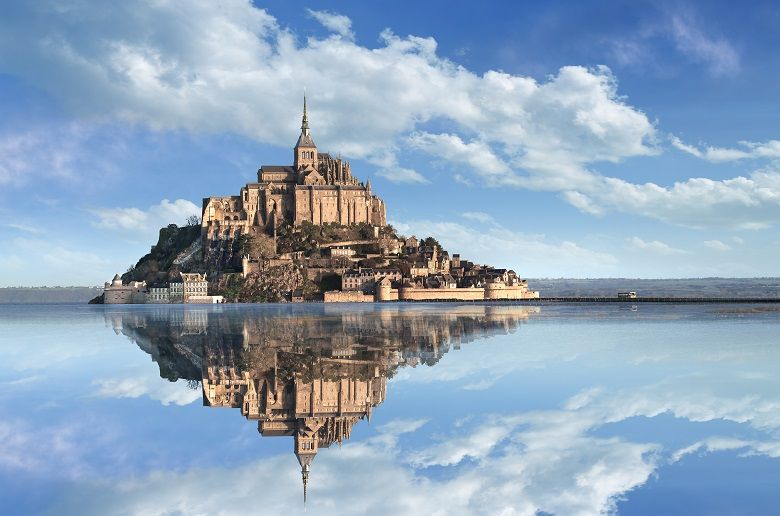
As technology reaches its peak, human connections begin to fracture. In the story, artificial wombs have become widespread, and the idea of “family” is disappearing: a young influencer cannot even understand the meaning of “blood ties.”
In Laputa, “Value Points” are the currency, but of course they do not reflect one’s true value—only the number of followers and likes.
There is also a system called “Link Request”: without sending a request, A cannot touch B in cyberspace, and will instead pass through B’s body like a ghost. The heroine once believed this system was genius. Yet this future makes it almost impossible for people to form real connections.
When We Still Dreamed of Linking
The protagonists leave the dazzling city behind and trace their way backward through the ruins of the Internet, revisiting its remains from the 1990s and 2000s.
Back then, the Internet was an open playground: without tech, without taste, people created a world so rich and colorful. Mostly, they earned nothing from it, not even a single Love Vote. Still, they poured their lives into it, willingly, with a foolish passion, as if—
“As if they were in love with this world,” Jonny says.
To write this part, I did a great deal of Internet archaeology. In the 2000s, personal homepages flourished. By today’s standards, they may look primitive, but people truly created them out of love, without thinking about gains and losses. Around 1990, Tim Berners-Lee created the World Wide Web with the dream that it would be “freely available to anyone.” I also explored BBS forums and MUD games from the 1980s, and looked further back to ARPANET in 1969, with only four nodes: the prototype of the Internet, and an image of human connection itself.
When I was writing the story back in 2019 (it was first published in Chinese in 2021), many creators, like Hideo Kojima and Kunihiko Ikuhara, were exploring the theme of connection—Perhaps it was a shared longing of the era.
New Apocalypses, New Hope
Traditional apocalypses depict the fall of civilizations, nuclear war, and the end of the world. But the apocalypse of our time is different. The world has become more chaotic, yet what is eating at us may be the emptiness within.
In today’s China, both adults and children are experiencing increasing psychological crises. This can be seen as a symptom of our age.
My recent work, “Palace of Silence,” the second novelette of my The Other Trilogy, explores this theme. After a climate crisis, the rich flee to the moon and become the Heavenlings, while the poor remain on Earth, barely surviving as the Earthlings. The Heavenlings possess unimaginable technology and every form of luxury, yet emptiness is eating away at their civilization.
So a Heavenling girl comes to Earth in search of “poetry,” or hope itself, and undertakes a cruel journey with an Earthling boy. In the end, she discovers that true poetry is not purple verses or beautiful imagery, but connection with a real Other.
The celestial pill is cold yet burning, resting in my palm together with her fingertips. We look at each other without words, and I hear a sound more beautiful than silence.
True poetry does not need language, but courage.
Today, apocalypses happen within us. When a person falls into despair, that is their personal end of the world. But even in such an apocalypse, we may still find our true life in the ruins.

20260428

